Choosing custom ice cream cups looks simple until you are staring at a supplier’s spec sheet with five sizes, three linings, four lid profiles, and a minimum order that suddenly makes the decision feel expensive. The cup is part of the product experience and part of your unit economics, so it pays to choose deliberately rather than defaulting to whatever the sample pack contained. Here is how to work through size, material, and finishing in the order that actually matters for a scoop shop, a caterer, or a packaged retail line.
Match the size to how it is served
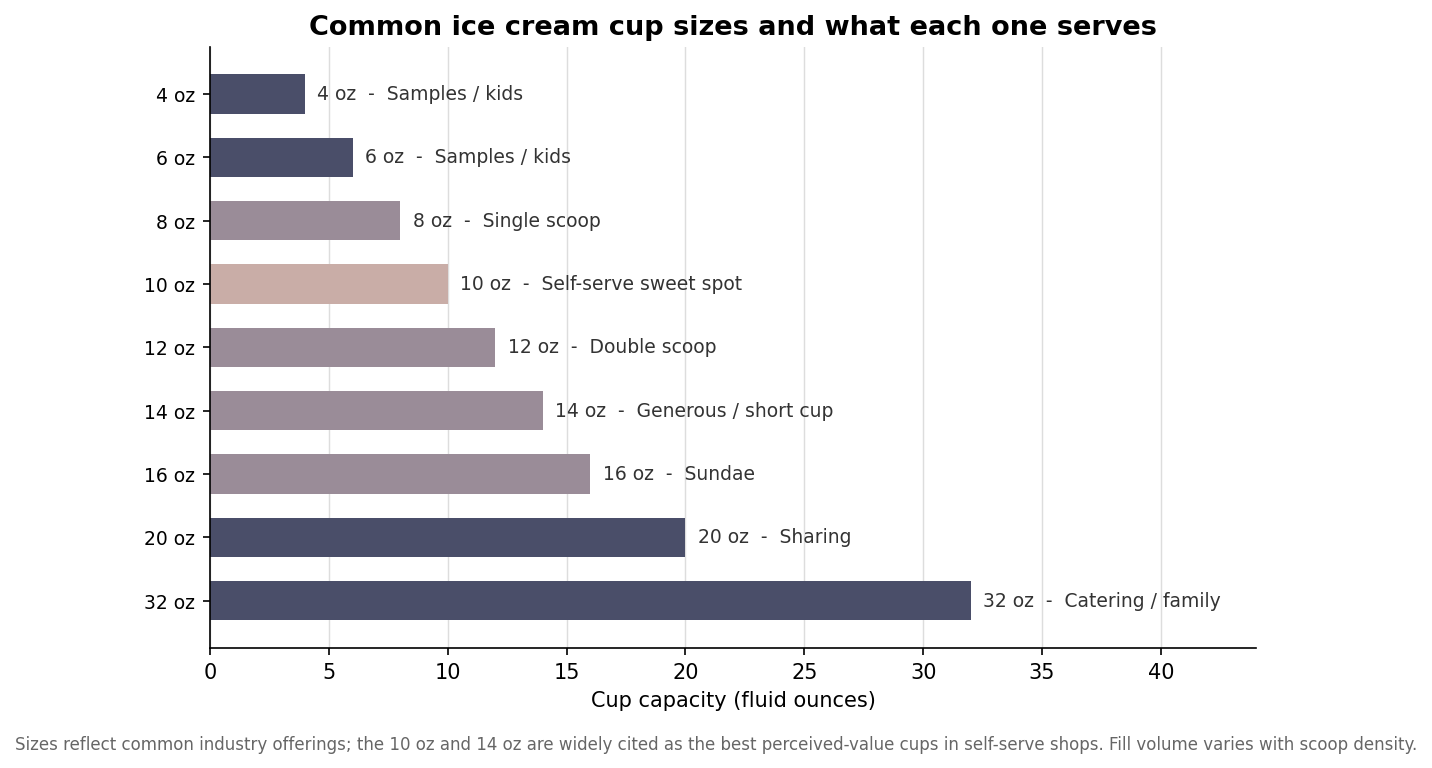
Capacity is the first decision because it drives everything downstream, from how the cup photographs to how much product you give away per serving. The common range runs from 4 oz sample and kids’ cups up to 32 oz family and catering tubs, and each size has a job. Small cups at 4 to 6 oz are for tastings, kids’ scoops, and sample giveaways. Single scoops sit around 8 oz, while the 10 oz cup is widely cited as the self-serve sweet spot because its wider diameter reads as generous without holding as much as it appears.
For fuller servings, 12 to 16 oz covers double scoops and sundaes, and a 14 oz “short” cup is a common trick: a wider, shorter shape that looks abundant while controlling volume. Above that, 20 to 32 oz cups are for sharing and catering. If you run a self-serve or by-weight model, remember that a bigger cup quietly increases the average sale, so size selection is a pricing decision as much as a packaging one.
A practical starting point for most shops is to carry two sizes, not five: one everyday cup and one larger option. Fewer sizes means larger runs per design, which lowers your unit cost and simplifies storage behind the counter.
Understand the lining before the paper
Paper ice cream cups are not just paper; they are paperboard with a thin waterproof lining, and that lining decides both performance and how the cup can be disposed of. Polyethylene (PE) lining is the low-cost standard. It is reliably moisture-resistant and handles cold product without issue, but it is not compostable and is difficult to recycle because the plastic film has to be separated from the fiber, which most curbside facilities will not do.
PLA lining is a plant-based alternative, typically made from corn starch, that is compostable in commercial composting facilities. Suppliers that make a genuine compostability claim should be able to point to certification such as ASTM D6400; a lining being “plant-based” is not the same as being certified compostable. PLA costs more than PE and, like PE, cannot go in with standard paper recycling. A third option, water-based coatings, is emerging as easier to recycle, though it usually sits at the higher end on price. For a cold product like ice cream you do not need the heat tolerance a hot cup requires, so the lining choice comes down mostly to your sustainability positioning and budget rather than performance.
Wall construction, lids, and the details buyers forget
Ice cream is cold, not hot, so the double- and ripple-wall insulation that matters for coffee is usually unnecessary here; a single-wall cup is the norm and keeps cost and shelf space down. Where the details do matter is the lid. Flat lids stack tightly and suit grab-and-go freezers. Low dome lids give a little room for toppings, and tall dome lids are the popular choice when sundaes and generous toppings are the selling point. If you are selling pre-packed retail units, a tamper-evident lid is worth the small premium for shelf credibility.
One easy mistake is ordering cups and lids that do not share a rim standard. Many ice cream cups use a common rim diameter around 95 mm, but this is not universal, so confirm that your chosen lid actually fits your chosen cup before you commit to either. Order a physical sample and put a lid on it; a photo on a listing is not proof of fit.
Printing, minimums, and lead time
Custom printing is where the economics get real. Because each design needs its own print plates and setup, custom cups carry a minimum order quantity, and 10,000 cups per design is a common floor. Per-unit cost then falls as you spread that fixed setup over more units, which is why 20,000 to 50,000 cups price meaningfully better than the minimum. If you run several flavors or seasonal art, consider printing one strong brand design rather than many small runs, so every order clears the setup cost efficiently.
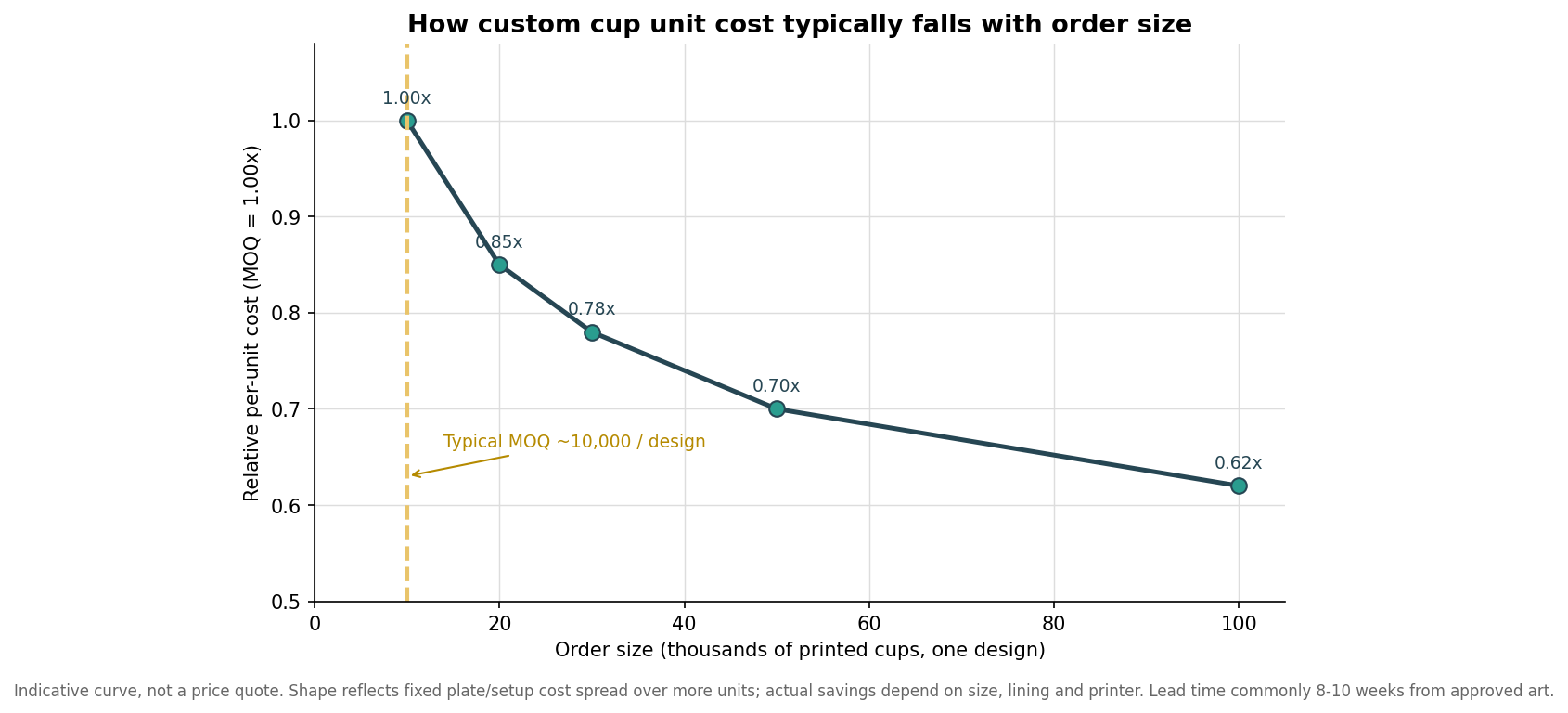
Plan the calendar, too. A typical custom run takes about 8 to 10 weeks from approved artwork, and that clock starts after proofing, not when you place the order. For a seasonal launch or a summer peak, that means locking artwork in spring. Keep your print-ready file simple and high-contrast; small cups do not hold fine detail well, and a bold logo reads better on the shelf and in a customer’s hand than a busy layout.
Putting it together by use case
For a scoop shop, two single-wall PE or PLA cups, an everyday 8 to 10 oz and a larger 16 oz, with matching flat and dome lids, cover almost every order and keep runs large. For events and catering, lean on 4 to 6 oz cups for portion control and crowd throughput, since smaller servings move faster and waste less. For a packaged retail line going into grocery freezers, prioritize a tamper-evident lid, a certified-compostable lining if sustainability is part of your brand story, and artwork built to catch the eye through freezer glass. In every case, decide size and lining first, confirm lid fit with a physical sample, and size your order to clear the minimum comfortably; do that and the cup stops being a guessing game and becomes a quietly reliable part of the product.